
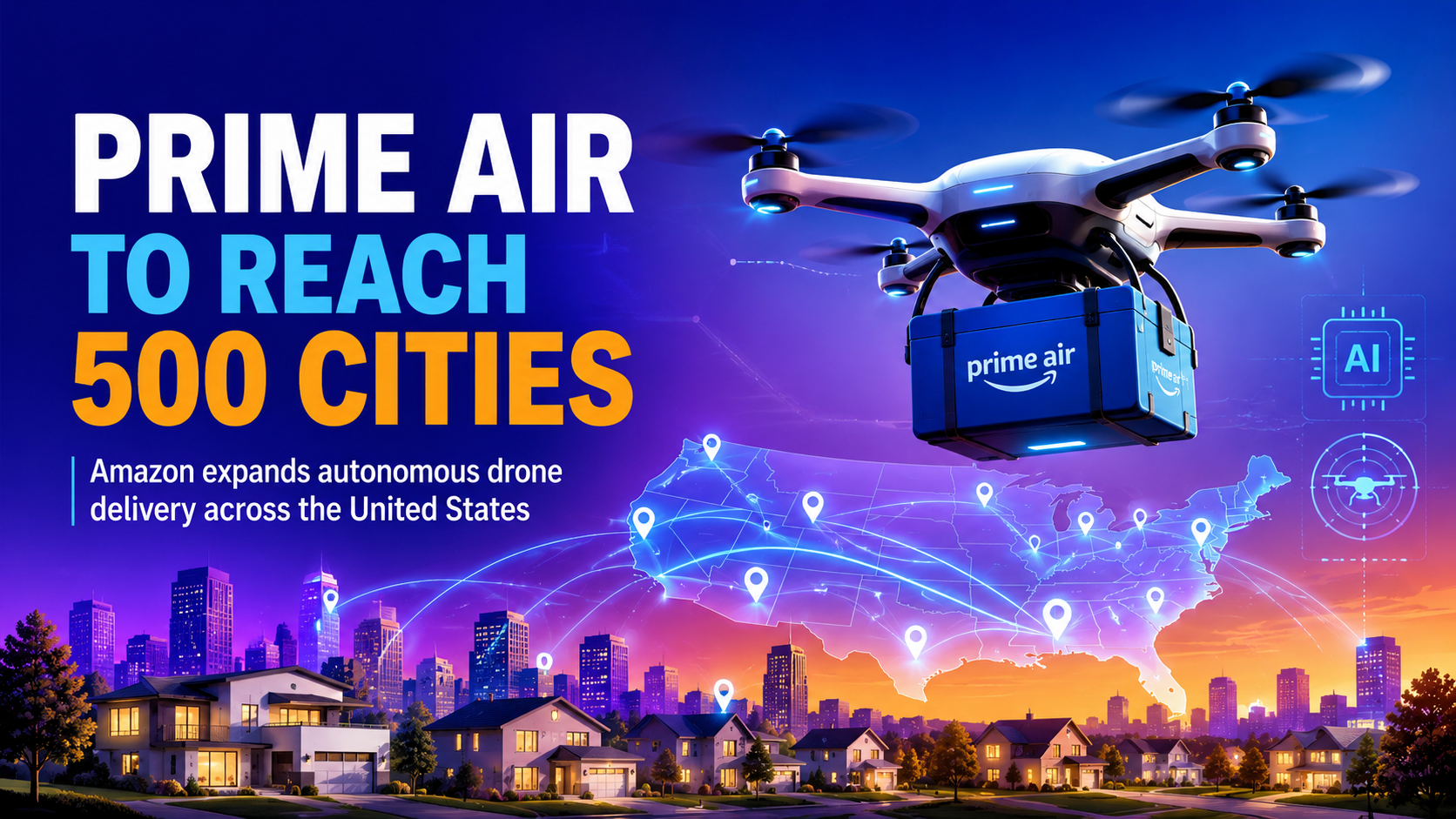
Amazon is significantly expanding its Prime Air autonomous drone delivery service, with plans to reach nearly 500 cities and towns across the United States by the end of 2026.
The expansion would represent a roughly sixfold increase from Prime Air’s current footprint and could bring ultrafast drone delivery to communities representing tens of millions of customers. Amazon says its drones can deliver eligible products in as little as 30 minutes.
The move is part of Amazon’s wider effort to use autonomous technology to make last-mile delivery faster. Prime Air is designed primarily for suburban areas, where drones can operate from dedicated delivery sites and avoid some of the challenges found in dense urban environments.
Quick Summary
- Amazon plans to expand Prime Air to nearly 500 US cities and towns by the end of 2026.
- The service currently operates from 11 US locations covering 10 metropolitan areas.
- Prime Air drones can carry eligible packages weighing up to 5 pounds.
- Some orders can arrive in as little as 30 minutes.
- Amazon says its drones use cameras, sensors and a Detect-and-Avoid system to navigate autonomously.
- Chicago, Atlanta, Cleveland, Syracuse and Boise are among the locations planned for upcoming launches.
Amazon Plans Major Prime Air Expansion
Prime Air currently operates from 11 locations across seven US states. Amazon says each site serves an area of approximately 175 square miles.
The company plans to add more locations throughout the year, with upcoming launches planned around Chicago, Syracuse, Cleveland, Atlanta and Boise. The exact ZIP codes covered by the service can change, and not every address in an eligible ZIP code will necessarily qualify for drone delivery.
Amazon says it has already delivered hundreds of thousands of packages by drone during 2026 and expects the network to reach customers in nearly 500 cities and towns before the end of the year.
How Amazon Prime Air Works
Prime Air is integrated into Amazon’s existing shopping experience.
Customers can shop through Amazon’s normal app and checkout process. If drone delivery is available for an eligible address and product, the option can appear during the shopping and checkout process.
For a first drone delivery, customers select a preferred delivery point. The location can be reused for future orders or changed when necessary.
When the drone reaches the delivery area, it checks the drop zone before releasing the package. Amazon says the system looks for people, pets and vehicles that could make the delivery unsafe.
Autonomous Technology Controls the Drone
The biggest technology behind Prime Air is its autonomous flight system.
Amazon says its drones use onboard cameras and sensors for navigation and obstacle detection. Its Detect-and-Avoid technology continuously monitors the surrounding environment and allows the aircraft to make real-time decisions during flight.
This is important because expanding drone delivery to hundreds of locations would be difficult if every aircraft required a person to manually control its flight.
Instead, Prime Air is designed around highly autonomous operation, allowing the drones to independently handle much of the flight process while following safety requirements.
Amazon also says the cameras used by Prime Air drones are designed for navigation and safety rather than tracking individuals. According to the company, the camera data is processed onboard and there is no person watching a live video feed from each drone.
What Can Amazon Deliver by Drone?
Prime Air is not limited to one type of product.
Amazon says millions of eligible products can be delivered through the service, including groceries, electronics, cosmetics, medications and household products.
The main restriction is package size and weight.
Eligible products generally need to weigh 5 pounds or less and fit inside a large shoebox. Amazon says this covers more than 60% of the products customers most frequently purchase on its platform.
Examples include smartphones, AirPods, AirTags, Ring doorbells, groceries and other household products.
How Fast Is Prime Air Delivery?
Speed is one of the main reasons Amazon is investing in drone delivery.
Prime Air can deliver eligible orders in as little as 30 minutes, although Amazon says most deliveries take closer to 60 minutes after checkout.
The service is therefore aimed at smaller, time-sensitive purchases rather than replacing Amazon’s traditional delivery network.
For customers who need a lightweight item quickly, a drone could potentially provide a faster option than waiting for a conventional delivery vehicle.
How Much Does Prime Air Cost?
Amazon has also introduced different pricing depending on the customer’s Prime membership and order value.
Prime members receive free drone delivery on eligible orders of $50 or more.
For Prime members placing eligible orders below $50, the drone delivery fee is $2.99.
Customers without a Prime membership pay $4.99 for the service.
The availability of the service and applicable delivery charges can vary by location and order.
Safety and FAA Approval
Scaling autonomous drones across hundreds of US communities requires more than just advanced software.
Prime Air operates under the Federal Aviation Administration’s Part 135 certification, a regulatory framework used for commercial air carriers. Amazon describes the certification as a major step in its ability to expand drone delivery operations.
Amazon says its drones are designed to handle unexpected situations and can use their safety systems to land safely when necessary.
The aircraft are also designed to operate in conditions such as light rain and different temperatures. The drones are fully electric and produce no exhaust emissions during operation.
Noise Could Still Be a Challenge
While drone delivery offers speed and automation, it also creates a new issue for residential communities: noise.
Amazon says the sound during a delivery is below that of an idling delivery truck and lasts for around 30 seconds. At cruising altitude, the company compares the sound to a window fan running at a low setting.
However, community acceptance will remain an important part of the expansion.
Local residents and regulators may have concerns about noise, safety, privacy and how frequently drones operate over residential areas. Independent reporting has also highlighted concerns and incidents involving Prime Air operations as the service expands.
Prime Air Is Part of a Larger Delivery Network
Amazon does not appear to be treating drones as a replacement for its entire delivery system.
Instead, Prime Air is one part of a broader network.
Amazon’s Same-Day Delivery network already serves millions of products across more than 10,000 cities and towns. The company also offers faster options such as Amazon Now and one-hour or three-hour delivery for selected products and locations.
Prime Air is mainly positioned for suburban areas where drone delivery can provide another fast option without sending a traditional delivery vehicle for every small order.
Amazon Is Taking Drone Delivery Beyond the US
Prime Air’s expansion is no longer limited to America.
Amazon recently launched Prime Air in Darlington, England, marking the first time the service became available outside the United States.
The UK operation gives Amazon an opportunity to operate its autonomous drone technology under a different national aviation regulatory environment.
This could become important if Amazon eventually expands the technology to more international markets.
A Real-World Test for Autonomous Delivery
The expansion comes as autonomous delivery technology faces a practical test.
Earlier this week, a Prime Air drone in Richmond, Texas, was filmed dropping a customer’s package into a swimming pool. The incident quickly attracted attention online and highlighted one of the challenges autonomous delivery systems face when dealing with real-world environments.
Amazon says its system checks the delivery area for people, pets and vehicles before releasing a package. But incidents like this show why autonomous delivery still requires continuous improvements in perception, navigation and drop-point selection.
What Amazon’s Expansion Means for the Future
Reaching nearly 500 cities would be a major test of whether autonomous drone delivery can move from a limited experiment to a meaningful part of everyday logistics.
If Amazon can maintain reliable delivery times while controlling safety, noise and operating costs, drones could become an important option for small and urgent purchases.
The technology could also reduce the need for some short-distance vehicle trips, although the overall environmental and economic impact will depend on factors such as drone utilization, energy use and how the deliveries fit into Amazon’s wider logistics network.
For now, Amazon’s target is clear: take Prime Air from a relatively small number of locations to nearly 500 US cities and towns by the end of 2026.
What Happens Next?
Amazon plans to continue launching Prime Air in additional metropolitan areas throughout 2026.
Chicago, Syracuse, Cleveland, Atlanta and Boise are among the next locations identified by Amazon, with additional communities expected to follow later in the year. Coverage will remain dependent on local availability and eligible delivery addresses.
The bigger question will be whether Amazon can scale the service while maintaining the safety and reliability expected from a mainstream delivery network.
FAQ
What is Amazon Prime Air?
Amazon Prime Air is an autonomous drone delivery service designed to deliver eligible products directly to customers using drones.
How many US cities will Prime Air reach?
Amazon plans to reach nearly 500 US cities and towns by the end of 2026, up from its current network of 11 delivery locations.
How fast can Amazon Prime Air deliver packages?
Eligible orders can arrive in as little as 30 minutes, although Amazon says most deliveries take around 60 minutes after checkout.
How much weight can Prime Air drones carry?
Prime Air generally supports eligible items weighing 5 pounds or less that can fit inside a large shoebox.
Is Amazon Prime Air available everywhere in the US?
No. The service is available only in selected locations. Amazon is expanding the network throughout 2026, but ZIP-code coverage can change and not every address in an eligible area qualifies.
Does Prime Air use autonomous flight technology?
Yes. Amazon says its drones use onboard cameras, sensors and a Detect-and-Avoid system to navigate, identify obstacles and make real-time safety decisions.